Take your place at an analyst’s desk. Examine case files, investigate details in images and connect your findings on an analysis board. Train, specialise and move your investigation forward with limited resources.
Grounded in real intelligence and security doctrine.
ALPINE: Operations is being developed on the basis of real-world intelligence and security doctrine. Publicly available doctrine and guidance from the OSCE and the United Nations inform the game’s approach to investigation and analysis.
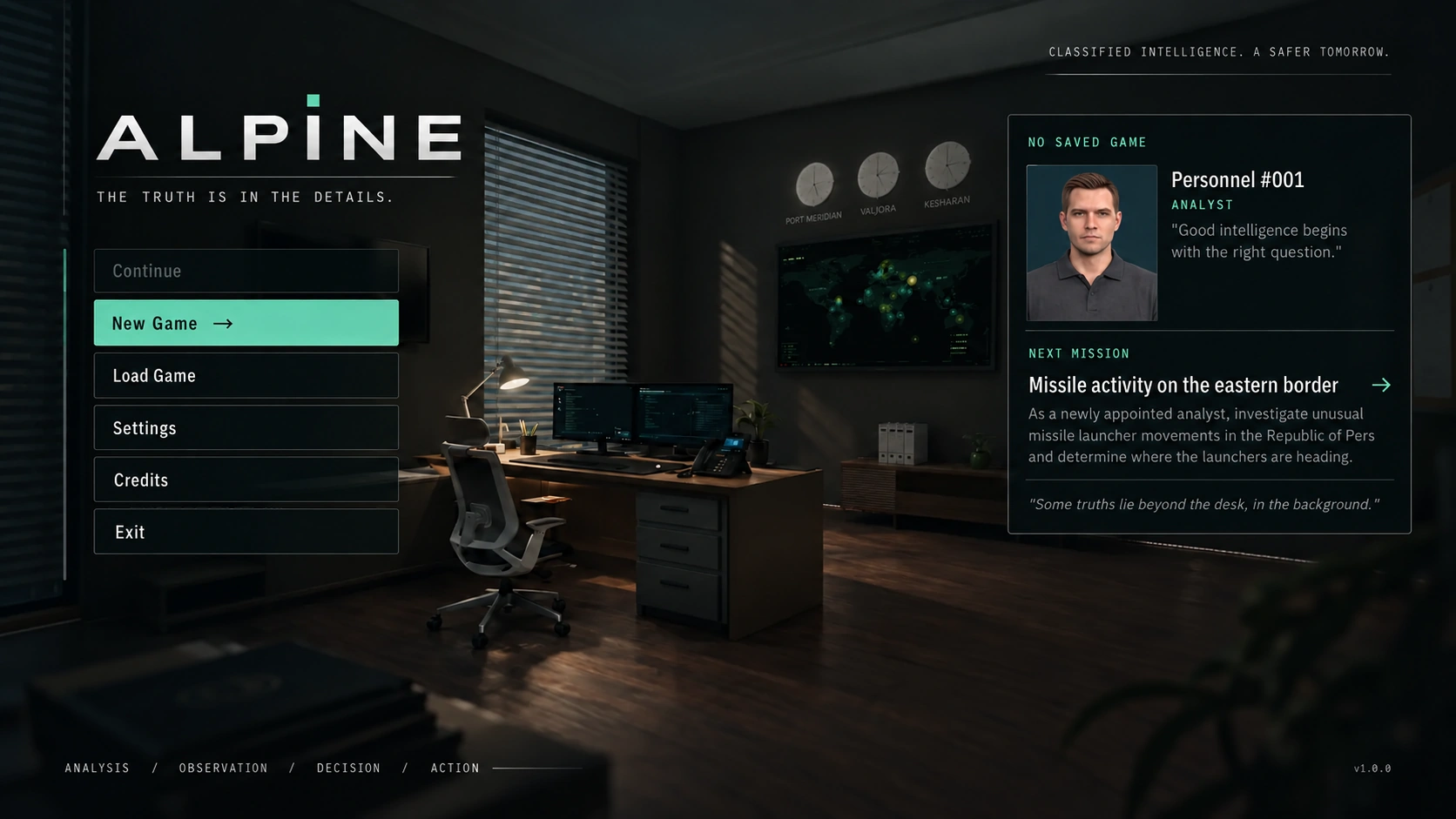
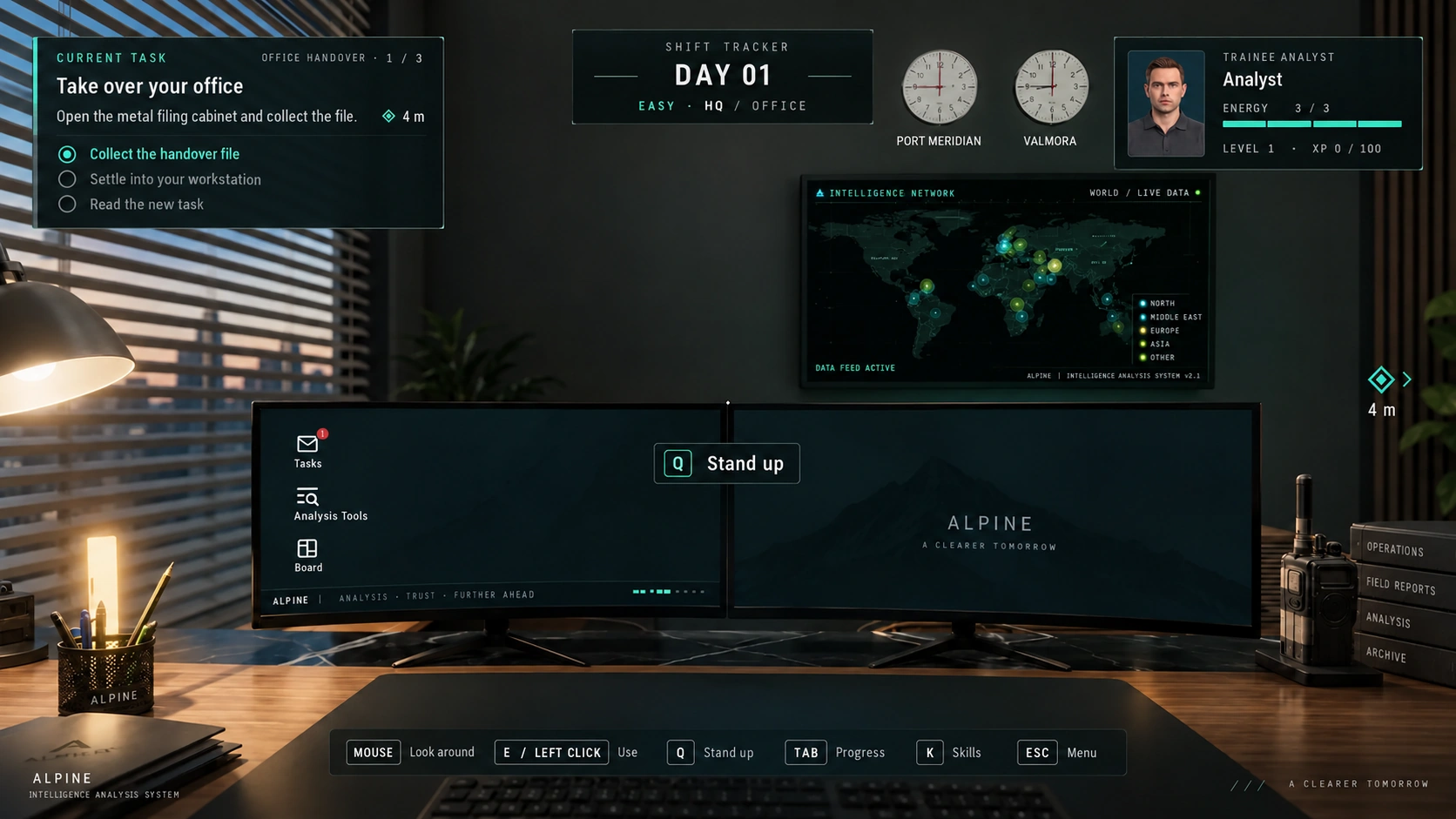
ALPINE: Operations puts you in the role of an analyst starting work at a fictional analysis centre. In first person, your office becomes the place where every part of an investigation comes together.
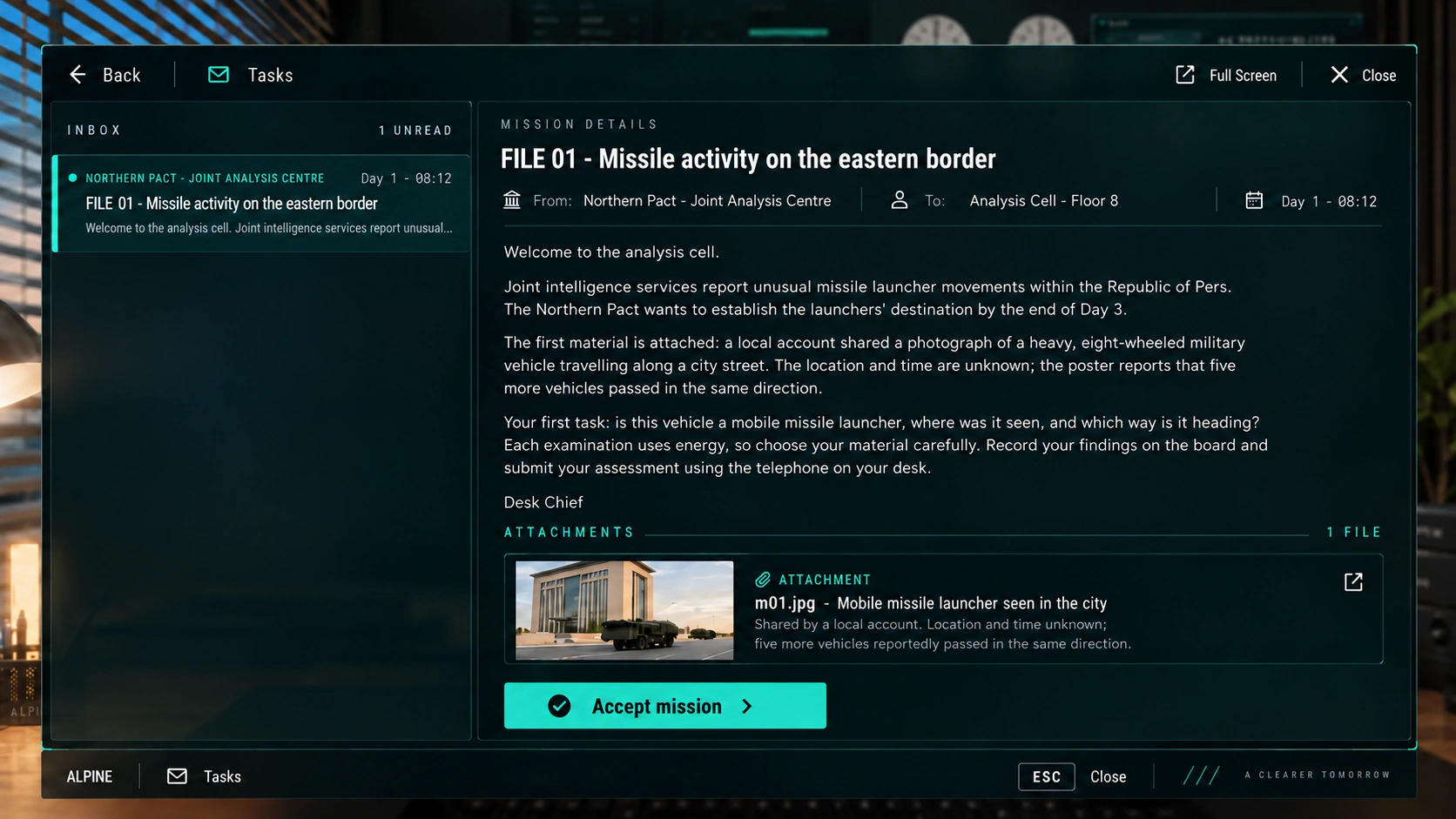
Read the briefings in your computer’s tasks application. Identify the questions, examine the attached material and take note of any deadline. Your desk, computer, phone, archive cabinet and analysis board are all part of the same workspace.
Select a specific object in an image, then decide which information source within the game could help you investigate it. A vehicle, a piece of equipment, a person or a building can each lead to a different question.
Researching the vehicle will not necessarily tell you where the photo was taken. A façade or a detail in the surroundings may be a better starting point. Choose the object and the source with your question in mind.
What kind of vehicle is it? Look for structural features that a relevant source could help identify.
A QUESTION TO FOLLOW
Its equipment
What might it carry? The equipment and individual parts may call for a different line of research.
A QUESTION TO FOLLOW
The building
Where was this photographed? Examine the façade and surrounding features for clues to the location.
INFORMATION SOURCES WITHIN THE GAME
Development visual · work in progress
03 / MAKE THE CONNECTIONS
Gather the information. Connect it yourself.
Bring your findings to your analysis board. Arrange photographs, add your own notes and join pieces of evidence with red threads. Describe what you think connects them.
Two images of the same place, complementary information or a relationship that needs another look: your board gives the investigation a structure you can work with.
ANALYSIS BOARDRELATIONSHIPS / WORKING NOTES
Case briefing and attached material
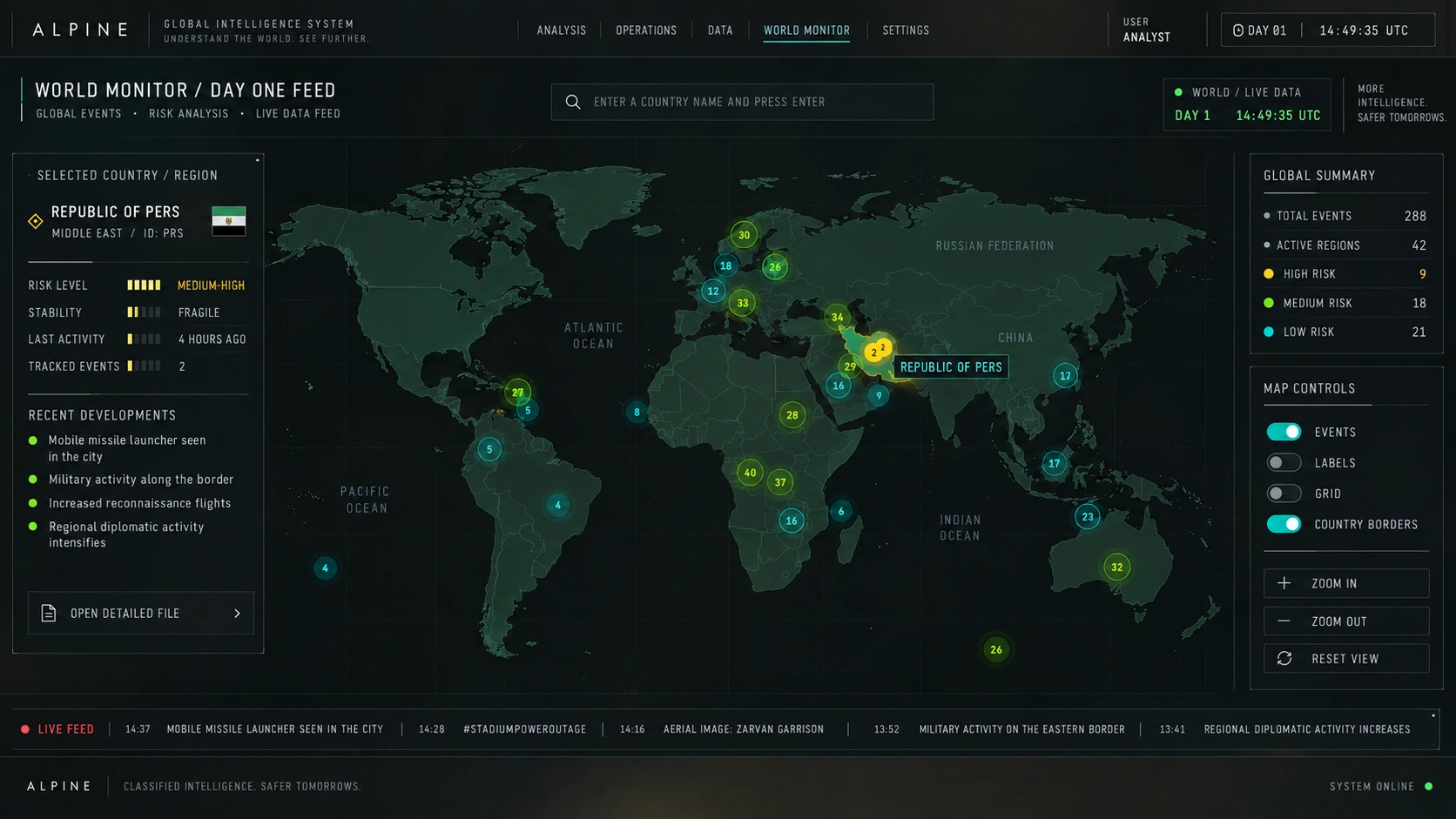
World monitoring interface
?
A connection is a question. Find the evidence to support it.
WHERE?
Photographs + your notes + relationships
Explanatory website diagram using development images. It does not show the board in the game.
04 / MANAGE YOUR RESOURCES
Every enquiry has a cost.
Decide which material deserves your attention and which source to consult next. You cannot follow every detail at once.
Energy and the searches remaining on a piece of material are separate resources. Plan around both, while keeping track of your working day in the game and any case deadline.
Consider your available energy when choosing the next step.
02
Examination attempts
Each piece of material has its own remaining search allowance.
03
Time within the game
Plan your working day and work towards the case deadline.
Development visual · work in progress
05 / DEVELOP YOUR EXPERTISE
Grow into the analyst.
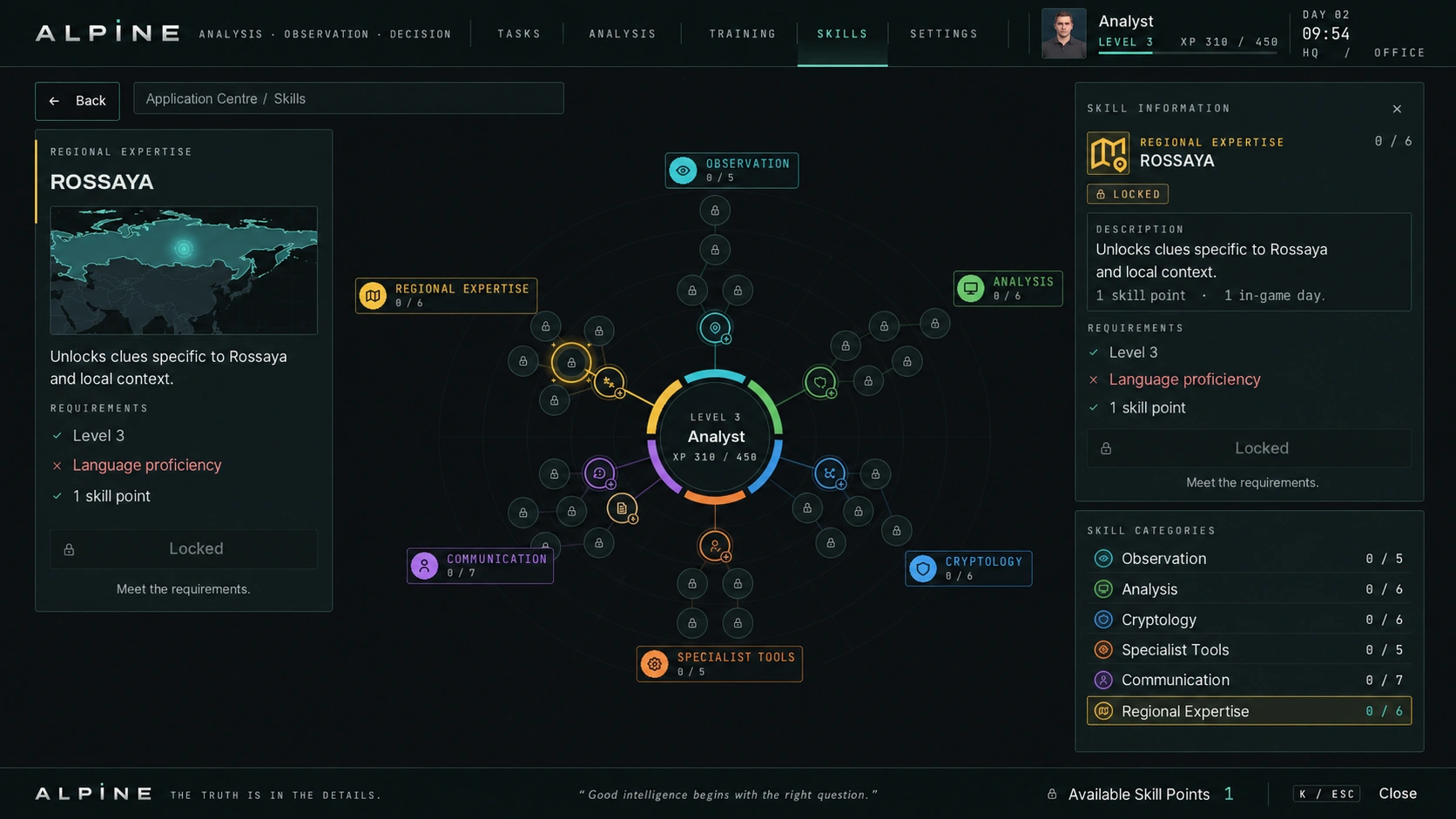
Complete training and solve cases to earn XP. Progress through the skill tree and shape your expertise step by step, with fields such as cryptology and regional knowledge.
Unlocking a skill can require a level, prerequisite knowledge, skill points or research time within the game. For example, regional expertise in Rossaya has level and language requirements, and opens up regional clues and local context.
Unlocks clues specific to Rossaya and local context.
Rossaya requirements
Level 3Met
Language proficiencyNot met
1 skill pointMet
Research time
1 in-game day
Locked in this screenshot: the language proficiency requirement has not been met.
06 / THE WORLD OF ALPINE: Operations
A fictional world. Concrete questions.
A FICTIONAL WORLD. A HUMAN PERSPECTIVE.
ALPINE: Operations · development visual
Work through incomplete information from fictional regions and institutions, including the Northern Pact Joint Analysis Centre. Behind each case is a question you must understand before you can find the evidence to answer it.
A quiet office, physical documents and focused software keep your attention on the work. The computer, the board and the room around you belong to one investigation.
CASE STUDY / THE FIRST QUESTIONS
One photograph. A military vehicle. Three unanswered questions.
A local account shares a photograph of a heavy military vehicle passing through a city street. No location or date is given. Other vehicles are reported to have travelled in the same direction.
Your task is to investigate the vehicle’s nature, the location and the direction of movement. Where will you begin: the vehicle, its equipment or the building behind it?
01 / IDENTIFY
What is the vehicle?
Examine its structure and equipment.
02 / LOCATE
Where was it seen?
Look for clues in its surroundings.
03 / ASSESS
Which way is it moving?
Bring the findings together before drawing a conclusion.
ALPINE: Operations / Development visual · work in progress
Inside ALPINE: Operations
A closer look at the office and the tools of the investigation.